Green Coffee Analysis
Grade Green Coffee Beans in Seconds
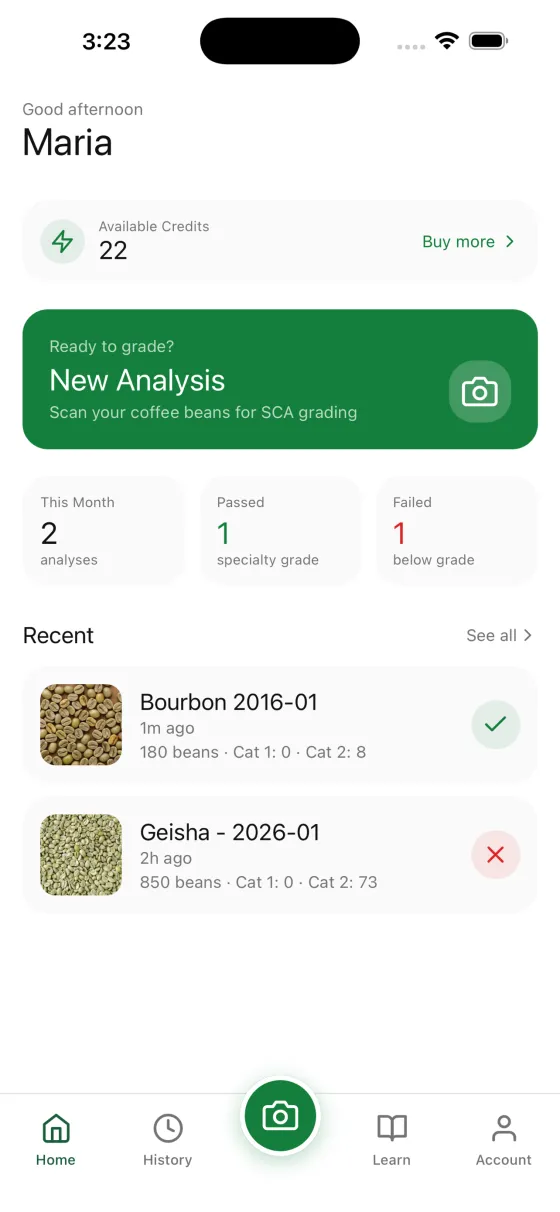
BeanGrader turns one photo of a green coffee sample into an SCA-aligned defect count, with a close-up crop of every bean it flagged, in seconds.
Defect detection for green coffee beans. Get indicative quality assessments aligned with SCA standards, with full Category 1 & 2 breakdowns.
For green coffee only. Designed for pre-screening and training, not a replacement for certified Q Graders.
Scan to install
Free to download • 3 free analyses included • No subscription
What BeanGrader is
Green coffee grading that shows its work
A grading instrument for the people who grow, buy, sell, roast and teach green coffee.
Screening a green coffee sample the traditional way means a scale, a tray, a trained eye and twenty minutes a lot. BeanGrader does the first pass from a single photograph: spread the sample, take one picture, and get a defect count classified against SCA green arabica methodology together with the cropped photo of every bean that drove the result. It is a pre-screening and training instrument, and it is built to be honest about what it can and cannot see.
One photo per sample
Spread the whole sample on a neutral surface and photograph it once. Large samples are tiled automatically on the server, so you never have to shoot section by section.
SCA defect classification
Category 1 and Category 2 defects are counted and weighted with the SCA equivalence factors, then rolled up into an indicative green arabica grade.
Per-bean photo evidence
Every flagged bean comes back as a close-up crop. You can see exactly which bean was called a full black or a broken, and disagree with it.
Coverage disclosure
Each result states how much of the sample was actually assessed, so a partial read is never presented as a complete one.
Confidence-labelled defects
Defects carry a confidence label rather than false precision. A borderline sour bean is reported as borderline.
Honest rejection, with the credit back
A photo taken too far away, too dark or too cluttered to grade properly is rejected and the credit refunded automatically, instead of being guessed at.
BeanGrader produces indicative assessments for pre-screening and training. It is not official SCA certification and does not replace a licensed Q Grader.
How it works
From sample tray to verdict in four steps
Spread the sample
Pour the green coffee onto a flat, evenly lit, neutral surface and spread the beans so they are not stacked on one another.
Take one photo
Photograph the whole sample from directly above. There is no need to shoot it in pieces: the server tiles a large sample and grades each tile.
Review the evidence
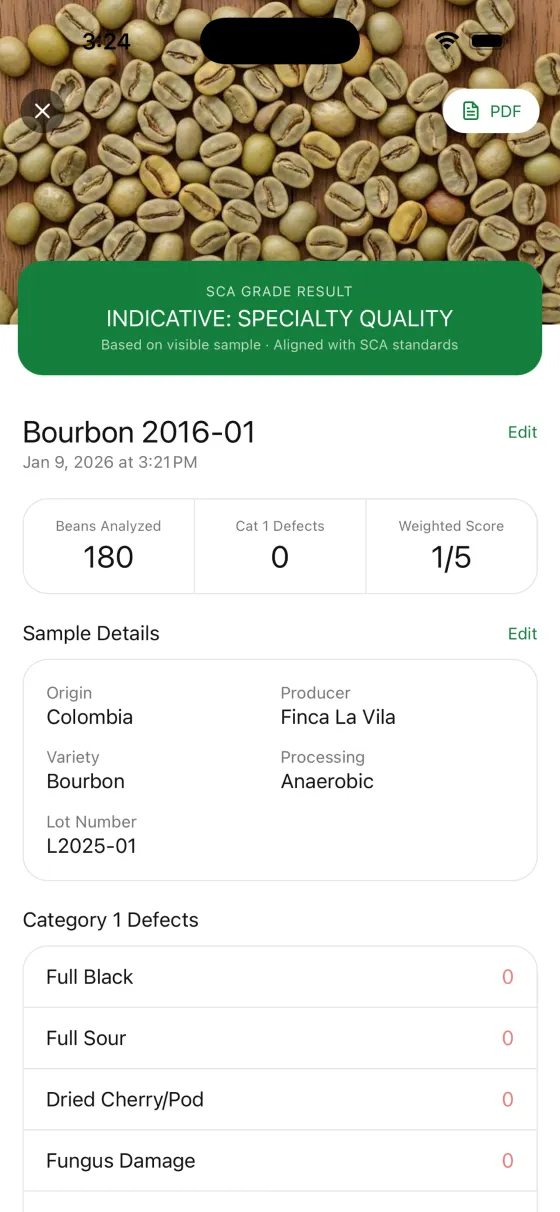
Read the defect list with a close-up crop of every flagged bean, the confidence label on each call, and how much of the sample was covered.
Issue the certificate
Export a PDF certificate carrying a verification code. Anyone can check that code at beangrader.com/verify without a BeanGrader account.
SCA grading
Counted the way the standard counts
SCA green arabica grading does not treat every defect equally. A single full black bean is a full defect on its own; it takes five slightly insect-damaged beans to make one. BeanGrader applies each defect type's equivalence factor, sums the full defects across the sample, and reports the grade that follows from the count, with the arithmetic on screen.
- Category 1 primary defects: full black, full sour, fungus damage, foreign matter, severe insect damage
- Category 2 secondary defects: partial black, partial sour, floater, immature, withered, shell, broken, husk, slight insect damage
- SCA equivalence factors applied per defect type, not a flat headcount
- An indicative grade from Specialty down to Below Standard, with the full defect maths shown
An indicative pre-screening result aligned with SCA methodology. It is not an official SCA certification.
Why you can trust the number
Built to be checked, not just to be fast
An assessment nobody can audit is worth very little on a trading floor. Every BeanGrader result carries its evidence and its caveats alongside the number.
See the bean, not just the count
Each flagged defect links to a cropped close-up of the bean it came from, so a disputed call is a picture you can look at rather than an argument you have to win.
Coverage is disclosed
The result states what proportion of the sample was assessed. If beans were stacked or fell outside the frame, the report tells you, not the buyer later.
Confidence, not false precision
Borderline calls are labelled borderline. A defect the analysis is unsure about is never presented with the same weight as an obvious one.
A rejected photo costs you nothing
A shot taken from too far away is rejected outright and the credit returned automatically. BeanGrader would rather decline than invent a grade.
Proof you can hand over
PDF certificates and public portfolios
Any analysis can be exported as a PDF certificate carrying the sample metadata, the defect breakdown, the evidence crops and a verification code. A buyer, an importer or an auditor enters that code at beangrader.com/verify and sees the same record, with no account and no app install.
Producers and exporters can go further and publish a public portfolio at beangrader.com/p/your-name: every lot graded, its origin, variety and process, and whether it cleared specialty grade. One link, sent to any buyer, anywhere.
See how producers use itLot passports
A passport the lot carries with it
Publish any graded lot as a shareable passport with a printable QR code. Producers print it on the bag; traders staple it to the offer sample. Whoever opens the bag scans the code and reads the same grading record we produced, evidence crops attached.
A passport is a link, not a file. There is nothing to email, nothing to lose in a thread, and no second version of the report that disagrees with the first.
- A printable QR that survives being stuck to a jute bag
- The full defect breakdown with its per-bean evidence, not a summary line
- Origin, variety, altitude and process travelling alongside the grade
- Readable by anyone with a phone camera: no account, no app install
Across lots
One sample is a reading. A season is a pattern.
Grading a single lot is only half the value. What a buyer actually needs to know is whether this supplier has been consistent, and whether what arrived is what was offered.
Supplier scorecards
Every lot you grade from a given supplier rolls up into one record: defect counts over time, how often their lots clear specialty, and which defects keep recurring.
Arrival against offer
Grade the offer sample, grade what arrives, and put the two readings side by side. A drift in the defect count becomes a conversation with evidence rather than an impression.
The same method at both ends
A comparison only means something if both readings were taken the same way. One method and one set of equivalence factors, at origin and at destination.
Training
A defect trainer built from real beans
The quiz is assembled from photographs of beans in graded samples rather than from illustrations, so what you learn to recognise is what the tray in front of you will look like.
- Call the defect from the bean, then check yourself against the classification
- Category 1 and Category 2 across the full defect set
- Useful for Q Grader preparation, barista programmes and classroom work
- The same defect vocabulary the grading uses, so practice and work agree
Features
Complete green coffee defect analysis
Everything you need to grade green coffee beans according to SCA standards.
Simple Photo Capture
Photograph your green coffee sample on any neutral surface. We handle the rest.
Instant Defect Analysis
Identifies and classifies coffee defects with precision.
SCA Classification
Full breakdown of Category 1 and Category 2 defects aligned with SCA methodology.
Sample Metadata
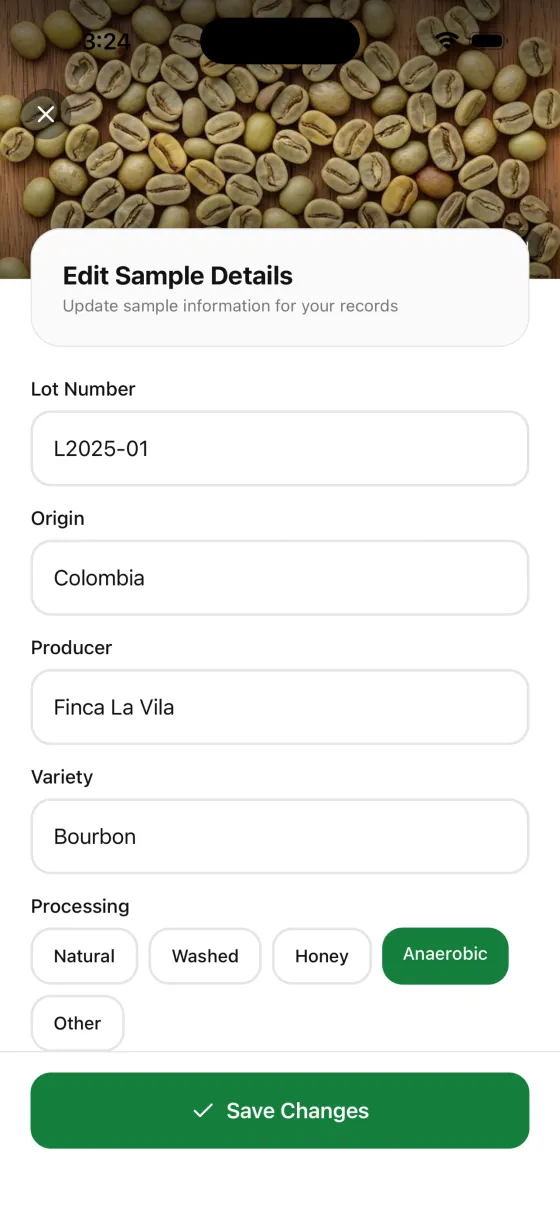
Track origin, producer, variety, and processing method. Context-aware analysis for better accuracy.
PDF Reports
Generate professional certificates with full analysis details, ready to share with clients.
Analysis History
Keep track of all your analyses with detailed results and defect summaries.
How It Works
How BeanGrader works
Pre-screening aligned with SCA green coffee standards
Photograph Sample
Spread your green coffee sample on a neutral surface and take a clear photo with your phone.
Defect Analysis
Identifies defects including full black, partial black, sour, fungus, insect damage, and more.
Get Results
Receive weighted defect scores, category breakdowns, and an indicative quality classification aligned with SCA green coffee standards.
Designed for pre-screening and training. Not a replacement for certified Q Graders or official SCA certification.
Who it's for
Wherever the sample gets opened
BeanGrader follows green coffee along the chain, from the drying patio to the training room.
Co-ops & mills
One shared standard across members
Give every member the same pre-screening method, so a conversation about lot quality starts from the same evidence.
Cafés & QC labs
A second opinion on the bench
A repeatable pre-screen that sits alongside your own cupping table and physical grading routine.
Simple Pricing
Buy credits, use when you need
No subscriptions, no expiration. Purchase analysis credits and use them whenever you're ready to grade your green coffee samples.
Loading packages...
One credit grades one sample. Credits are bought once and stay on the account until they are spent. If we cannot read a photo well enough to grade it honestly, we reject the photo and refund the credit.
Contact
Get in Touch
Have questions about BeanGrader? We'd love to hear from you.
Response Time
We typically respond within 24 hours
FAQ
Frequently Asked Questions
Everything you need to know about BeanGrader
Ready to grade your green coffee?
Download BeanGrader and get 3 free analyses for your green coffee bean samples.
Free to download • 3 free analyses included • No subscription